


OPENTUNITY explores policy and regulatory challenges for flexibility in European electricity grids
An internal policy workshop held on 1 October brought together project partners to examine regulatory barriers to distribution-level flexibility, discuss lessons from the pilot demonstrations and shape recommendations for the project’s final policy deliverable.
As Europe’s electricity system becomes increasingly decentralised, flexibility is gaining importance as a way to manage congestion, integrate renewable energy and make better use of existing grid infrastructure.
However, regulatory differences, limited network visibility and barriers to market participation can still hinder its wider deployment.
These challenges were at the centre of the OPENTUNITY Internal Policy Workshop, held on 1 October 2026. The session reviewed regulatory approaches across European countries and explored how the project’s findings could contribute to more effective frameworks for flexibility procurement and activation.
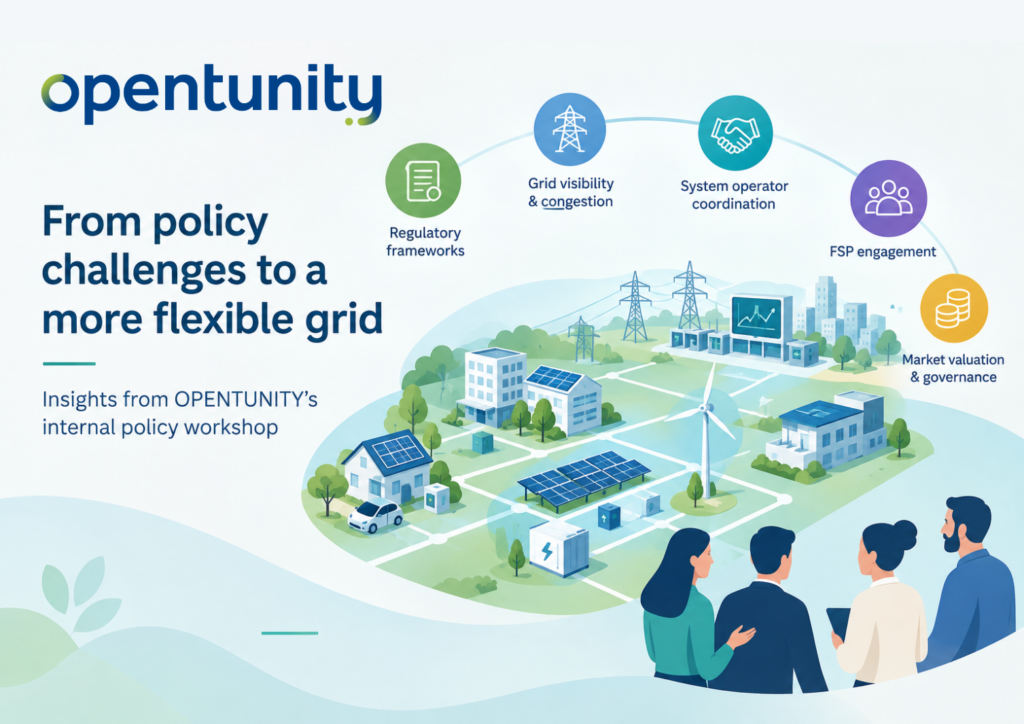
Five key challenges for flexibility deployment
Discussions highlighted five interconnected areas requiring further attention:
- Diverging national regulations: Different approaches to implementing EU electricity market rules can slow the development of flexibility markets. Regulatory sandboxes and pilot schemes offer opportunities to test new mechanisms before their wider adoption.
- Limited low-voltage grid visibility: Incomplete monitoring and delays in smart meter data can make it difficult for distribution system operators (DSOs) to identify and manage local congestion in real time.
- Coordination between system operators: Effective flexibility activation requires better coordination between transmission and distribution system operators, as well as between neighbouring or interconnected distribution networks.
- Barriers to participation: Smaller flexibility service providers, including households, farmers and municipal facilities, may face high entry costs, administrative complexity and concerns about financial penalties.
- Economic incentives and market governance: Existing regulatory frameworks can favour traditional grid reinforcement over flexibility procurement, underlining the need for clearer valuation methodologies and suitable market arrangements.
The workshop also emphasised that technical solutions alone are not enough. Building trust among participants, demonstrating tangible local benefits and ensuring that participation costs remain proportionate to potential revenues are important to encourage wider engagement in flexibility markets.
 From project findings to policy recommendations
Experiences from the OPENTUNITY pilots provided a practical basis for discussing how digital platforms and coordination mechanisms can support flexibility services. In particular, the Greek demonstration highlighted workflows for coordination between transmission and distribution system operators.
Participants also examined different models for flexibility platform governance, the role of dynamic tariffs compared with market-based flexibility procurement, and opportunities to harmonise flexibility products across Europe. Greater convergence in areas such as minimum bid sizes, response times and verification procedures could help reduce fragmentation and support wider market development.
Next steps
The workshop marks an important step towards OPENTUNITY’s final policy and regulatory recommendations, which will consolidate the challenges identified, the solutions explored through the project and the remaining gaps that need to be addressed.
The next steps include updating the policy analysis, preparing a structured matrix linking regulatory bottlenecks with project solutions and areas for further work, and organising a follow-up workshop with external stakeholders, including DSOs, regulators, aggregators and flexibility service providers.
The feedback gathered will contribute to the final policy deliverable, planned for December 2026, helping translate OPENTUNITY’s findings into recommendations to support the wider adoption of flexibility solutions across Europe.