


OPENTUNITY Contributes to CWA on Peer-to-Peer Energy Trading
CWA 50784:2026 provides a European framework for assessing the impact of P2P energy trading on distribution grids, bringing together lessons from research and innovation projects to support the wider deployment of energy communities and local flexibility.
As OPENTUNITY enters its final months, one of the project’s contributions is reaching beyond the project itself. CENELEC has officially published CWA 50784:2026 – Impact of P2P trading at distribution grid level, a new Workshop Agreement developed through collaboration between the OPENTUNITY and FEDECOM projects.
The document is now publicly available for free download through the CENELEC website, providing a common European reference for understanding how peer-to-peer (P2P) and peer-to-pool energy trading can affect electricity distribution networks.
From project innovation to a common European framework
P2P energy trading is gaining attention as energy communities and distributed energy resources become an increasingly important part of Europe’s energy system. However, enabling users to trade energy and flexibility locally also raises questions about grid capacity, congestion, voltage management, data exchange and interoperability.
CWA 50784:2026 addresses these challenges by providing a framework to assess and quantify the impact of P2P and peer-to-pool trading at low- and medium-voltage distribution grid level.
The agreement brings together expertise from energy technology, research, industry and standardisation, helping translate lessons from European R&I activities into a shared approach that can support future deployment.
For OPENTUNITY, this work is particularly relevant to the project’s objective of connecting local flexibility, digitalisation and interoperable grid operation with real-world energy system needs.
Bringing the DSO perspective into P2P trading
One of the key contributions from OPENTUNITY is the distribution system operator (DSO) perspective.
While P2P trading is often considered primarily from the perspective of market transactions between consumers and prosumers, these exchanges also have a direct impact on the physical electricity network. More decentralised generation and consumption can create new patterns of power flows, congestion and voltage variations that need to be monitored and managed.
The OPENTUNITY approach addresses this technical dimension through advanced grid observability and flexibility management.
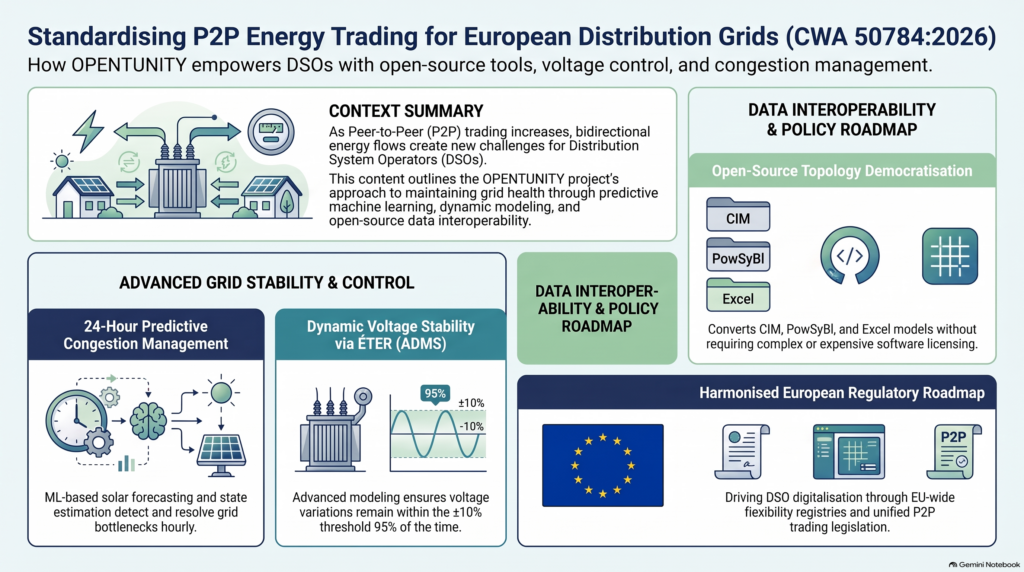
Short-term renewable generation forecasts and state estimation can be used to anticipate network conditions and identify potential congestion. When flexibility is needed, this information can support the activation of local flexibility services before network constraints become critical.
The project also explores how an advanced ADMS environment can help DSOs assess voltage variations associated with distributed energy resources and ensure that network performance remains within the applicable quality limits.
Making grid interoperability more accessible
Another important contribution concerns network topology and interoperability.
For P2P energy trading and other flexibility-based services to scale, different platforms and actors need to be able to work with compatible representations of the electricity network. However, adopting complex standardised models and digital tools can be challenging, particularly for smaller and medium-sized DSOs.
OPENTUNITY has therefore developed an open-source approach to network topology conversion and visualisation, supporting interoperability between different network modelling formats, including CIM, PowSyBl and Pandapower, as well as more accessible formats such as Excel.
This work can help DSOs integrate and visualise network information without depending on complex or highly specialised software environments, lowering some of the barriers to digitalisation and interoperability.
Supporting the next step towards market adoption
The publication of CWA 50784:2026 represents an important step in connecting research, standardisation and market deployment.
The agreement highlights the need for appropriate regulatory and digital frameworks to enable P2P and peer-to-pool trading at scale. This includes clearer approaches to the roles of different market actors, data exchange, settlement mechanisms and the interaction between local energy markets and distribution grid operation.
It also underlines the importance of giving DSOs the digital capabilities needed to understand and manage the network impacts of increasing local energy trading and flexibility.
For European R&I projects such as OPENTUNITY, this type of standardisation activity provides an opportunity to ensure that project results do not remain isolated demonstrations, but can contribute to common approaches that facilitate replication and future uptake.
CWA 50784:2026 now available
The CWA 50784:2026 – Impact of P2P trading at distribution grid level is now officially published by CENELEC and available free of charge through its CWA download area.
The Workshop Agreement was developed under the FEDECOM and OPENTUNITY projects, with contributions from organisations across the energy, research and standardisation communities.
The publication is not only a project milestone, but also an example of how European collaborative research can contribute to the common frameworks needed to move innovative energy solutions towards wider deployment.