


Month: September 2026
OPENTUNITY Contributes to CWA on Peer-to-Peer Energy Trading
CWA 50784:2026 provides a European framework for assessing the impact of P2P energy trading on distribution grids, bringing together lessons from research and innovation projects to support the wider deployment of energy communities and local flexibility.
As OPENTUNITY enters its final months, one of the project’s contributions is reaching beyond the project itself. CENELEC has officially published CWA 50784:2026 – Impact of P2P trading at distribution grid level, a new Workshop Agreement developed through collaboration between the OPENTUNITY and FEDECOM projects.
The document is now publicly available for free download through the CENELEC website, providing a common European reference for understanding how peer-to-peer (P2P) and peer-to-pool energy trading can affect electricity distribution networks.
From project innovation to a common European framework
P2P energy trading is gaining attention as energy communities and distributed energy resources become an increasingly important part of Europe's energy system. However, enabling users to trade energy and flexibility locally also raises questions about grid capacity, congestion, voltage management, data exchange and interoperability.
CWA 50784:2026 addresses these challenges by providing a framework to assess and quantify the impact of P2P and peer-to-pool trading at low- and medium-voltage distribution grid level.
The agreement brings together expertise from energy technology, research, industry and standardisation, helping translate lessons from European R&I activities into a shared approach that can support future deployment.
For OPENTUNITY, this work is particularly relevant to the project's objective of connecting local flexibility, digitalisation and interoperable grid operation with real-world energy system needs.
Bringing the DSO perspective into P2P trading
One of the key contributions from OPENTUNITY is the distribution system operator (DSO) perspective.
While P2P trading is often considered primarily from the perspective of market transactions between consumers and prosumers, these exchanges also have a direct impact on the physical electricity network. More decentralised generation and consumption can create new patterns of power flows, congestion and voltage variations that need to be monitored and managed.
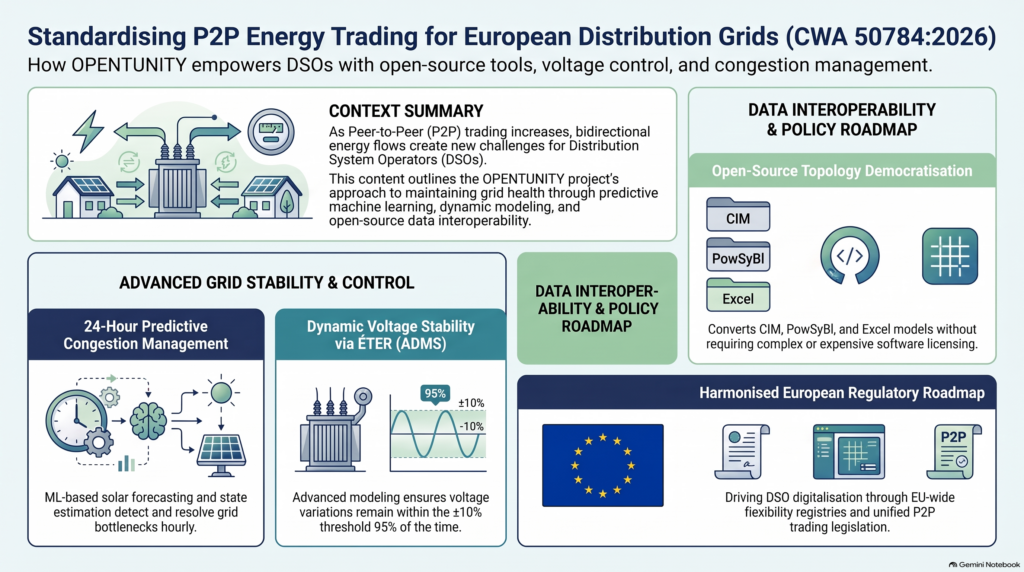
The OPENTUNITY approach addresses this technical dimension through advanced grid observability and flexibility management.
Short-term renewable generation forecasts and state estimation can be used to anticipate network conditions and identify potential congestion. When flexibility is needed, this information can support the activation of local flexibility services before network constraints become critical.
The project also explores how an advanced ADMS environment can help DSOs assess voltage variations associated with distributed energy resources and ensure that network performance remains within the applicable quality limits.
Making grid interoperability more accessible
Another important contribution concerns network topology and interoperability.
For P2P energy trading and other flexibility-based services to scale, different platforms and actors need to be able to work with compatible representations of the electricity network. However, adopting complex standardised models and digital tools can be challenging, particularly for smaller and medium-sized DSOs.
OPENTUNITY has therefore developed an open-source approach to network topology conversion and visualisation, supporting interoperability between different network modelling formats, including CIM, PowSyBl and Pandapower, as well as more accessible formats such as Excel.
This work can help DSOs integrate and visualise network information without depending on complex or highly specialised software environments, lowering some of the barriers to digitalisation and interoperability.
Supporting the next step towards market adoption
The publication of CWA 50784:2026 represents an important step in connecting research, standardisation and market deployment.
The agreement highlights the need for appropriate regulatory and digital frameworks to enable P2P and peer-to-pool trading at scale. This includes clearer approaches to the roles of different market actors, data exchange, settlement mechanisms and the interaction between local energy markets and distribution grid operation.
It also underlines the importance of giving DSOs the digital capabilities needed to understand and manage the network impacts of increasing local energy trading and flexibility.
For European R&I projects such as OPENTUNITY, this type of standardisation activity provides an opportunity to ensure that project results do not remain isolated demonstrations, but can contribute to common approaches that facilitate replication and future uptake.
CWA 50784:2026 now available
The CWA 50784:2026 – Impact of P2P trading at distribution grid level is now officially published by CENELEC and available free of charge through its CWA download area.
The Workshop Agreement was developed under the FEDECOM and OPENTUNITY projects, with contributions from organisations across the energy, research and standardisation communities.
The publication is not only a project milestone, but also an example of how European collaborative research can contribute to the common frameworks needed to move innovative energy solutions towards wider deployment.


Smart Grids in Practice: OPENTUNITY Brings Flexibility into the Discussion
On 10 September 2026, energy professionals and researchers gathered in Ljubljana, Slovenia, for “Smart Grids in Practice: Experiences and Results from European Projects STREAM and OPENTUNITY”, an event organised by Elektro Ljubljana and the University of Ljubljana.
Bringing together around 30 participants from distribution and transmission system operators, technology companies, research organisations and the energy media, the event provided an opportunity to present the results emerging from both projects and, importantly, to discuss how these experiences can translate into practical changes in the energy system.
From project results to practical discussions
OPENTUNITY was represented throughout the event by several project partners, providing different perspectives on the project's work and its results.
Janez Gregor Golja from the University of Ljubljana opened the OPENTUNITY contributions with an overview of the project's objectives, innovations, pilot sites and current stage, highlighting some of the main outcomes from the demonstration activities carried out across the four pilots, as well as the project's cross-platform demonstrations.
The presentations then moved into specific examples of how OPENTUNITY technologies are being applied and tested in practice. Amibit presented its Reduxi HEMS system and its work within the project on heat pump flexibility, coordination with Elektro Ljubljana, NILM participation and user research. Elektro Ljubljana shared its experience as a DSO and data provider, including the processes required to make operational data available for testing OPENTUNITY's DSO-focused tools, such as ICCS's short- and long-term asset management and grid planning solutions.


Other contributions connected OPENTUNITY's work with broader questions around flexibility and electrification. Avantcar discussed the challenges and opportunities associated with the rapid growth of e-mobility and highlighted the OPENTUNITY solution developed with Kolektor sETup for optimising EV charging schedules according to day-ahead electricity prices. The approach significantly reduced charging costs for the part of the fleet where it was tested.
How can flexibility support smarter grid development?
The event's two roundtable discussions provided an opportunity to move from project results towards some of the practical challenges facing the energy sector.
The first discussion focused on the DSO perspective and the value of flexibility. Participants explored where flexibility can be most useful for network operators and what regulatory, technical and operational changes may be needed to make greater use of it.
 One of the key ideas discussed was the potential of flexible connections to make better use of existing grid capacity. Instead of dimensioning networks exclusively around occasional peaks, flexibility could in some situations allow certain assets to temporarily adjust their consumption or generation when network constraints occur. This could help operators accommodate additional renewable generation or new connections while potentially delaying or reducing some infrastructure investments.
The discussion also highlighted that flexibility should not be seen as a replacement for traditional grid reinforcement. Its value depends on the specific network conditions, the reliability of the flexibility service and the regulatory and contractual framework governing its use.
Connecting flexibility with the growth of e-mobility

The second roundtable focused on e-mobility, looking at both the challenges created by the rapid electrification of transport and the opportunity for EVs to become an additional source of flexibility for the electricity system.

EV charging infrastructure can create new peaks in electricity demand, but smart charging and other flexibility mechanisms can also turn these assets into a resource for grid management. The experience presented by Avantcar within OPENTUNITY provided a concrete example of how charging schedules can be optimised while reducing costs.
This dual role of electric vehicles as both a new source of demand and a potential flexibility resource, will become increasingly relevant as EV adoption continues to grow.
From European projects to real-world change
The event demonstrated the value of bringing project partners and energy-sector stakeholders together to discuss not only what has been developed, but also how these solutions could work in practice.
For OPENTUNITY, the discussions provided an opportunity to share the results of its demonstrations while gathering perspectives from actors directly involved in operating and developing electricity networks. The exchange also highlighted some of the remaining challenges that need to be addressed if flexibility is to become a reliable and scalable tool for the future energy system.
As OPENTUNITY approaches the final months of the project, these discussions are particularly relevant:
the focus is increasingly shifting from developing and demonstrating individual innovations towards understanding their practical impact, scalability and potential contribution to a more flexible and resilient European grid.

OPENTUNITY puts its innovations to the test across four pilots
Over the past year, OPENTUNITY has moved from developing its innovations to putting them to the test in real distribution grids, households, and energy markets. Across four pilot sites in Greece, Slovenia, Spain, and Switzerland, the project deployed and demonstrated its full set of tools for grid operators, prosumers, and flexibility markets under operating conditions. Work package 6 (WP6), coordinated by the University of Ljubljana, marks the point where years of design and development met the complexity of the real world.
A coordinated, evidence-based demonstration
Demonstrating a large set of innovations across four countries required careful coordination. Building on the demonstration plan defined in the first phase of WP6, each pilot worked through a structured set of test cases, with progress tracked systematically across all sites through regular coordination meetings. A dedicated monitoring process kept close watch on the datasets flowing from pilot partners to the technology developers, ensuring that every tool had the data it needed to be tested properly. In total, more than fifty test cases were executed, each documented with concrete evidence of what was deployed, how it was demonstrated, and what the outcome was.
Connecting tools to real infrastructure
Turning a working prototype into a tool running on live infrastructure is not straightforward. Sensors had to be installed on transformers and power lines, data pipelines built between utility systems and the project's platforms, and software connected to everything from household heat pumps to EV charging stations. This integration effort, often the least visible part of a project, was essential groundwork that made the demonstrations possible. - UL, Work Package 6 coordinator.
Results from across the four pilots
Each pilot brought something distinct to the project. Here are a few highlights, with more detailed pilot-focused articles to follow in the coming months.
- In the Greek pilot, HEDNO and IPTO demonstrated a flexibility market on the NODES platform that coordinated needs between the transmission and distribution operators, alongside a transformer health-monitoring tool that flagged real anomalies across high-voltage assets.
- In the Swiss pilot, AEM and its partners ran a local flexibility market for an energy community in Massagno that operated continuously and autonomously across 49 trading days, matching bids and dispatching real assets without manual intervention.
- In the Spanish pilot, ANELL operated a real-time thermal rating tool live on a 40 kV overhead line for roughly ten months, while a state estimation tool gave the operator visibility into low-voltage grids that are normally difficult to observe, reaching voltage estimation with very high accuracy.
- In the Slovenian pilot, smart charging of a shared EV fleet cut the gap to optimal charging cost by more than half in two months of real operation, while a network planning tool showed that even modest flexibility could defer grid reinforcement investments by several years.

What comes next
These demonstrations provide the evidence base for the next phase of the project, where OPENTUNITY will formally assess the impact of its innovations against the project's targets. In the meantime, watch this space for upcoming articles taking a closer look at each pilot and what it achieved.