


OPENTUNITY explores the potential of distributed flexibility at SST 2026
The growing number of photovoltaic (PV) systems, batteries, heat pumps and electric vehicles is transforming low-voltage electricity grids. These distributed assets offer significant flexibility potential, but how much of it can actually be used to support grid operations?
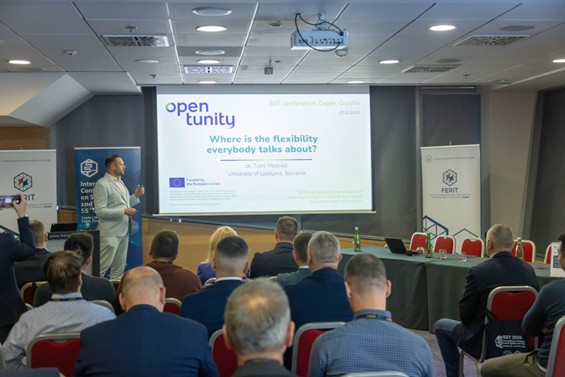
This question was at the centre of a keynote delivered by Tomi Medved from the University of Ljubljana (UL) at SST 2026 – the International Conference on Smart Systems and Technologies, held in Osijek, Croatia, from 28 to 30 October 2026.
Organised by the Faculty of Electrical Engineering, Computer Science and Information Technology Osijek (FERIT), the conference brought together around 150 participants from the scientific community, industry and policy-making sector to exchange knowledge and discuss developments in smart systems and technologies.
Unlocking flexibility in low-voltage grids
During his keynote, Tomi Medved examined the growing role of decentralised energy resources and the new opportunities they create for electricity distribution system operators (DSOs).
Smart EV charging, vehicle-to-grid (V2G) solutions and home batteries are enabling new business models and changing how flexibility can be provided and managed. However, significant challenges remain before this potential can be fully harnessed.
In particular, making distributed flexibility accessible to DSOs requires answering several key questions:
where is flexibility located, how much is reliably available, who owns and operates these assets, and what is their actual value?
The presentation also explored mechanisms that could help address these challenges, including local flexibility markets, flexible connection agreements and appropriate regulatory frameworks. These approaches can allow DSOs to make more efficient use of existing grid capacity and potentially defer costly grid reinforcement.
OPENTUNITY’s contribution to flexibility management
The keynote drew on the work carried out within OPENTUNITY, particularly the experience of its Slovenian pilot, which explores flexibility from electric vehicle fleets and household assets such as heat pumps, PV systems and batteries.
The project is developing an approach to aggregate and select flexibility from heterogeneous distributed energy resources according to the needs of DSOs. By making these resources more visible and accessible, OPENTUNITY aims to support their integration into grid operation and facilitate more efficient use of available flexibility.
The discussions at SST 2026 reinforced the growing relevance of these solutions. As the costs of PV systems and batteries continue to decrease, distributed flexibility is becoming an increasingly attractive resource for future energy systems. The interest shown by researchers and DSOs also highlighted the importance of continued collaboration between the scientific community and industry.
Beyond the technical discussions, the event provided an opportunity to strengthen the relationship between the University of Ljubljana and FERIT, while opening new avenues for exchange with the regional research and DSO community.
OPENTUNITY’s participation in SST 2026 contributed to sharing the project’s findings and advancing the discussion on how distributed flexibility can support smarter, more efficient and more resilient electricity grids.