


Putting Flexibility to the Test: New Progress from OPENTUNITY’s Spanish Pilot
As OPENTUNITY moves into the final phase of the project, its Spanish pilot is progressing from technology validation towards real-world demonstration. In recent months, Estabanell, ETRA and Hypertech have been working together to validate the project’s solutions with distribution teams and to test flexibility activation in the pilot environment.
These activities are providing valuable feedback on both the technical performance of the solutions and their potential use in day-to-day grid operation.
Validating OPENTUNITY tools with distribution teams
As part of the pilot activities, Estabanell recently completed a series of internal presentations of ETER and the ICCS tools with the Distribution System Operator’s operations teams. The sessions provided an opportunity to introduce the technologies to potential end users, demonstrate their functionalities and collect feedback based on their operational experience.
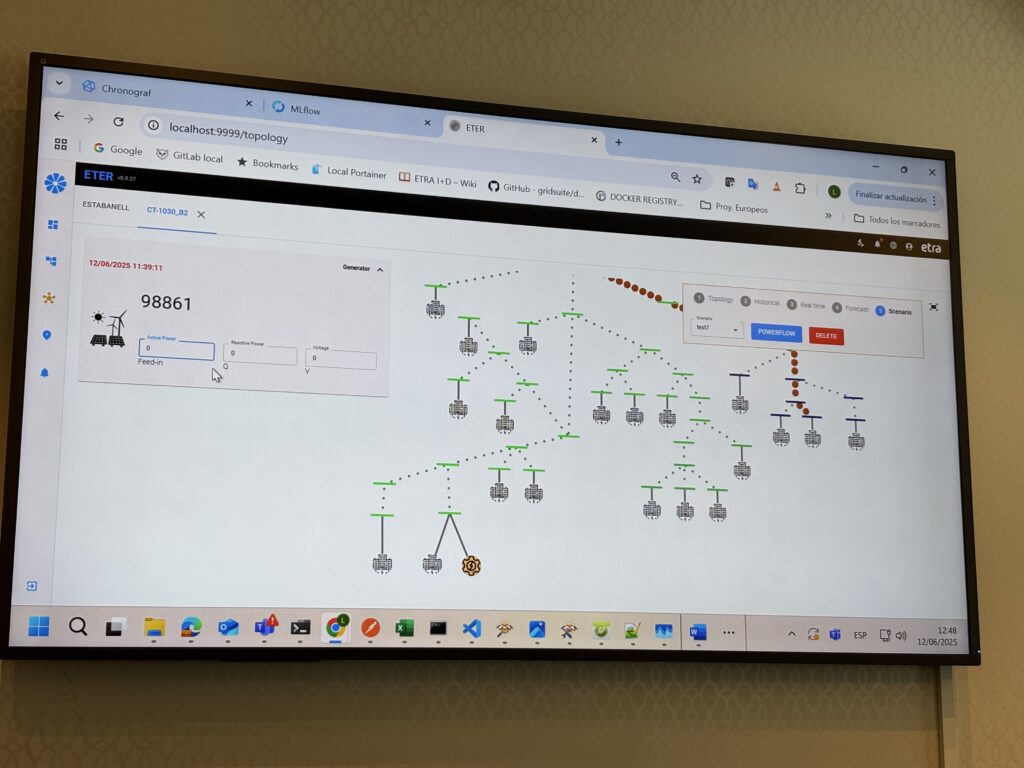
Overall, the feedback was positive, with particular interest in three functionalities that are currently not covered by Estabanell’s existing applications. These include capabilities offered by both ETER and the ICCS tools.
One of the aspects that attracted most attention was ETER’s ability to bring together different data sources in a single environment. By combining real-time information from medium- and low-voltage networks with state estimation algorithms, ETER’s digital twin can provide enhanced observability of the distribution grid.
The teams also highlighted the potential of ETER to support scenario analysis and operational planning. The tool can be used to explore how future changes in grid operation could affect power flows, as well as to assess how the availability of flexibility could help alleviate potential congestion.
Another area of interest was the advanced asset management tool developed by ICCS, particularly its potential to support decisions when purchasing new smart meters by providing additional information on their expected reliability and performance.
The sessions also identified aspects of the solutions that still require further refinement. This feedback will be used by the project partners to improve the tools and strengthen the user experience ahead of the next stages of the pilot.
Moving towards real flexibility activation
Alongside the validation of the technologies with distribution teams, the Spanish pilot has also taken an important step towards demonstrating flexibility in practice.
During the last weeks of July, ETRA, Estabanell and Hypertech carried out the flexibility activation tests planned for the pilot. The activities will continue throughout August, allowing the partners to further assess the performance of the solution and prepare for the next stages of the demonstration.
An encouraging result from the tests carried out so far is that flexibility activations have taken place without users noticing any impact on their service or comfort. This is an important aspect of the demonstration, showing how flexibility can be activated to support the electricity system while maintaining a seamless experience for end users.
The ongoing tests will provide further insights into how the different components developed within OPENTUNITY work together in a real pilot environment. Once the pilot is completed, the partners will analyse the results and share the main conclusions and lessons learned.
From technology validation to real-world demonstration
The latest activities mark an important transition for the Spanish pilot. By combining feedback from distribution professionals with practical flexibility activation tests, OPENTUNITY is moving beyond the development of individual technologies towards integrated, real-world validation.
The coming months will focus on completing the remaining demonstrations and analysing the results, helping the project assess how its solutions can contribute to more observable, flexible and efficient distribution grids while keeping end users at the centre.