


Month: July 2025

What Citizens Really Think: Smart Tools, Simpler Markets, and Informed Choices
At OPENTUNITY, we believe that real innovation begins with understanding people. That’s why our project continues to ask:
What do energy users need, want, and understand about the energy transition?
In this second round of stakeholder engagement via social media surveys, we explored perceptions around consumer empowerment, smart technologies, and barriers to participation. The insights help us refine the tools and strategies we’re developing, making the energy system not only smarter, but more inclusive.
Energy Markets: Still Too Complex for Most Citizens
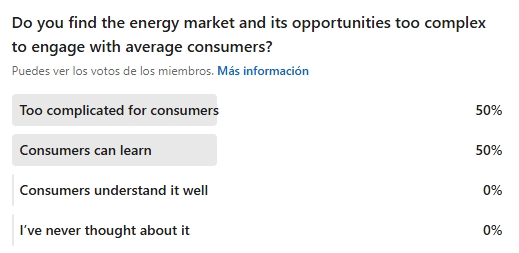
Half of the respondents believe the energy market is too complicated for the average consumer, while the other half thinks consumers are slowly learning to navigate it. No one believed that consumers fully understand it.
Similarly, when asked whether consumers are aware of their ability to actively participate (e.g., via demand response or selling excess energy), a combined 86% said only a minority knows or participates, and 43% said “almost nobody knows.”
This perception gap highlights the need for clearer communication, education, and digital interfaces that guide citizens, something OPENTUNITY addresses through its local engagement campaigns, pilot demonstrations, and work package on knowledge transfer (WP8).
It also reinforces the importance of EU efforts like the Clean Energy Package, which aims to strengthen consumer rights and awareness in the evolving energy market.
Cost Is Still the Top Priority
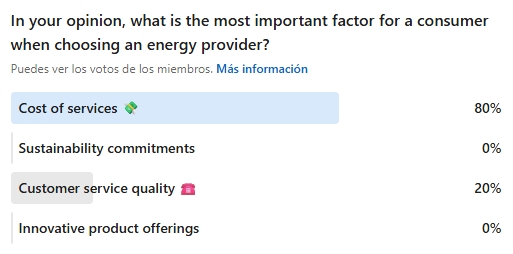
We also asked: What really matters when choosing an energy provider? A resounding 80% of respondents selected "Cost of Services", while 0% chose “Sustainability Commitments”.
This sends a strong message: while climate awareness is rising, economic pressure remains the primary driver of consumer behavior. OPENTUNITY acknowledges this reality by focusing on solutions that reduce energy costs while enabling environmental gains, such as enabling flexible demand and self-consumption.
 As energy prices remain volatile across Europe, especially in the context of geopolitics and the EU Green Deal, ensuring that smart = affordable is crucial for adoption.
Citizens Want Smart, Practical Solutions
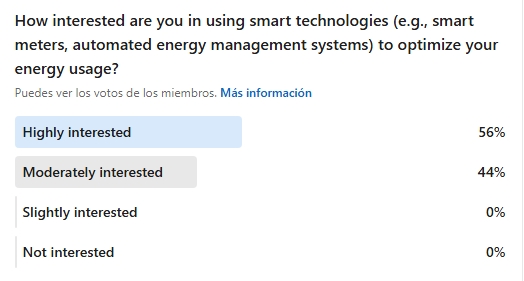
When asked about their interest in using smart tools (like smart meters or automated energy management systems), 100% of respondents expressed interest, with 56% being highly interested. This confirms a clear trend: people are open to digital technologies that give them control over their consumption, especially when they simplify complex decisions.
This enthusiasm reinforces our strategy: OPENTUNITY is working to deliver intuitive, impactful digital tools that allow users to take control of their energy usage without needing expert knowledge. These include:
- AI-based energy management systems (EMS).
- Predictive analytics tools for asset health monitoring (e.g., transformers).
- User dashboards for flexibility participation.
- And upcoming energy awareness apps for consumers.
These tools are designed to turn real-time data into actionable guidance, making energy-saving decisions accessible to everyone, not just experts.
Energy Decisions Are Social
Surprisingly, 100% of respondents said friends and family have an impact on energy-related choices, with most rating it as “moderately impactful.”
This social dimension of energy behavior confirms that peer influence, community engagement, and trust-building are key levers. It validates our pilot strategies in Slovenia, Spain, Switzerland, and Greece; where OPENTUNITY combines technical deployment with citizen workshops, local surveys, and real-world demonstrations.
Smart Tools as Habit-Changers
Finally, 100% of participants believe that smart tools can help change our energy habits to be more sustainable. This overwhelming consensus aligns perfectly with OPENTUNITY’s mission.
From smart home integrations to predictive maintenance and flexibility services, we are working on tools that don’t just monitor, they guide, recommend, and empower. The goal: create a feedback loop where data leads to action, and action leads to savings, both economic and environmental.
From Feedback to Features
Each of these survey results fuels the design and delivery of OPENTUNITY’s innovations. Whether through AI-powered analytics, intuitive dashboards, or community-based pilots, we are building a smarter, more inclusive energy system, one that listens, adapts, and empowers.
Because the energy transition won’t succeed without the people it’s meant to serve.


OPENTUNITY is developing an advanced Short-Term Asset Management Tool
Reliable operation of power grids depends heavily on the health and performance of critical infrastructure components, especially assets like transformers. Unplanned outages and equipment failures can cause significant disruptions, operational inefficiencies, and a decline in customer trust. Traditional maintenance approaches, often based on routine inspections or scheduled servicing, do not always detect emerging problems in time and can result in unnecessary interventions.
To address these challenges, the OPENTUNITY project is pioneering a smarter, more proactive approach to asset management.
Advanced Monitoring Powered by Machine Learning

As part of this mission, ICCS has developed an advanced Short-Term Asset Management Tool that leverages real-time sensor data and cutting-edge machine learning techniques. This innovative solution enables Distribution and Transmission System Operators (DSOs and TSOs) to monitor, analyze, and protect their most valuable grid components more effectively.
By processing high-frequency data from key equipment, such as transformer oil temperature and dissolved gas levels, the tool applies predictive algorithms to detect early signs of deterioration or failure. These insights empower operators to act before problems escalate, minimizing downtime and avoiding costly repairs.
Operator-Centric Design for Real-World Use
To ensure seamless integration into daily operations, ICCS has also finalized a user-friendly interface 
tailored to the needs of grid operators. Through a clear and interactive dashboard, users can monitor the health of all critical assets at a glance, receive real-time alerts about abnormal conditions, and access six-hour-ahead forecasts of key parameters.
The tool employs industrial standards and advanced anomaly detection methods, delivering both situational awareness and actionable intelligence. This allows operators to transition from reactive maintenance to predictive intervention, ultimately improving system reliability and efficiency.
Benefits for Grid Resilience and Efficiency
With its powerful analytics engine, intuitive design, and predictive capabilities, the Short-Term Asset Management Tool is set to become a cornerstone of data-driven asset management in the energy sector. Among its key benefits:
- Reduced operational and maintenance costs.
- Minimized equipment failure and downtime.
- Extended lifespan of critical assets.
- Improved grid stability and service continuity.
By combining advanced technology with practical application, OPENTUNITY is redefining how utilities safeguard the backbone of their infrastructure, making the grid smarter, greener, and more resilient.