


pilot sites

OPENTUNITY puts its innovations to the test across four pilots
Over the past year, OPENTUNITY has moved from developing its innovations to putting them to the test in real distribution grids, households, and energy markets. Across four pilot sites in Greece, Slovenia, Spain, and Switzerland, the project deployed and demonstrated its full set of tools for grid operators, prosumers, and flexibility markets under operating conditions. Work package 6 (WP6), coordinated by the University of Ljubljana, marks the point where years of design and development met the complexity of the real world.
A coordinated, evidence-based demonstration
Demonstrating a large set of innovations across four countries required careful coordination. Building on the demonstration plan defined in the first phase of WP6, each pilot worked through a structured set of test cases, with progress tracked systematically across all sites through regular coordination meetings. A dedicated monitoring process kept close watch on the datasets flowing from pilot partners to the technology developers, ensuring that every tool had the data it needed to be tested properly. In total, more than fifty test cases were executed, each documented with concrete evidence of what was deployed, how it was demonstrated, and what the outcome was.
Connecting tools to real infrastructure
Turning a working prototype into a tool running on live infrastructure is not straightforward. Sensors had to be installed on transformers and power lines, data pipelines built between utility systems and the project's platforms, and software connected to everything from household heat pumps to EV charging stations. This integration effort, often the least visible part of a project, was essential groundwork that made the demonstrations possible. - UL, Work Package 6 coordinator.
Results from across the four pilots
Each pilot brought something distinct to the project. Here are a few highlights, with more detailed pilot-focused articles to follow in the coming months.
- In the Greek pilot, HEDNO and IPTO demonstrated a flexibility market on the NODES platform that coordinated needs between the transmission and distribution operators, alongside a transformer health-monitoring tool that flagged real anomalies across high-voltage assets.
- In the Swiss pilot, AEM and its partners ran a local flexibility market for an energy community in Massagno that operated continuously and autonomously across 49 trading days, matching bids and dispatching real assets without manual intervention.
- In the Spanish pilot, ANELL operated a real-time thermal rating tool live on a 40 kV overhead line for roughly ten months, while a state estimation tool gave the operator visibility into low-voltage grids that are normally difficult to observe, reaching voltage estimation with very high accuracy.
- In the Slovenian pilot, smart charging of a shared EV fleet cut the gap to optimal charging cost by more than half in two months of real operation, while a network planning tool showed that even modest flexibility could defer grid reinforcement investments by several years.

What comes next
These demonstrations provide the evidence base for the next phase of the project, where OPENTUNITY will formally assess the impact of its innovations against the project's targets. In the meantime, watch this space for upcoming articles taking a closer look at each pilot and what it achieved.

Putting Flexibility to the Test: New Progress from OPENTUNITY’s Spanish Pilot
As OPENTUNITY moves into the final phase of the project, its Spanish pilot is progressing from technology validation towards real-world demonstration. In recent months, Estabanell, ETRA and Hypertech have been working together to validate the project’s solutions with distribution teams and to test flexibility activation in the pilot environment.
These activities are providing valuable feedback on both the technical performance of the solutions and their potential use in day-to-day grid operation.
Validating OPENTUNITY tools with distribution teams
As part of the pilot activities, Estabanell recently completed a series of internal presentations of ETER and the ICCS tools with the Distribution System Operator’s operations teams. The sessions provided an opportunity to introduce the technologies to potential end users, demonstrate their functionalities and collect feedback based on their operational experience.
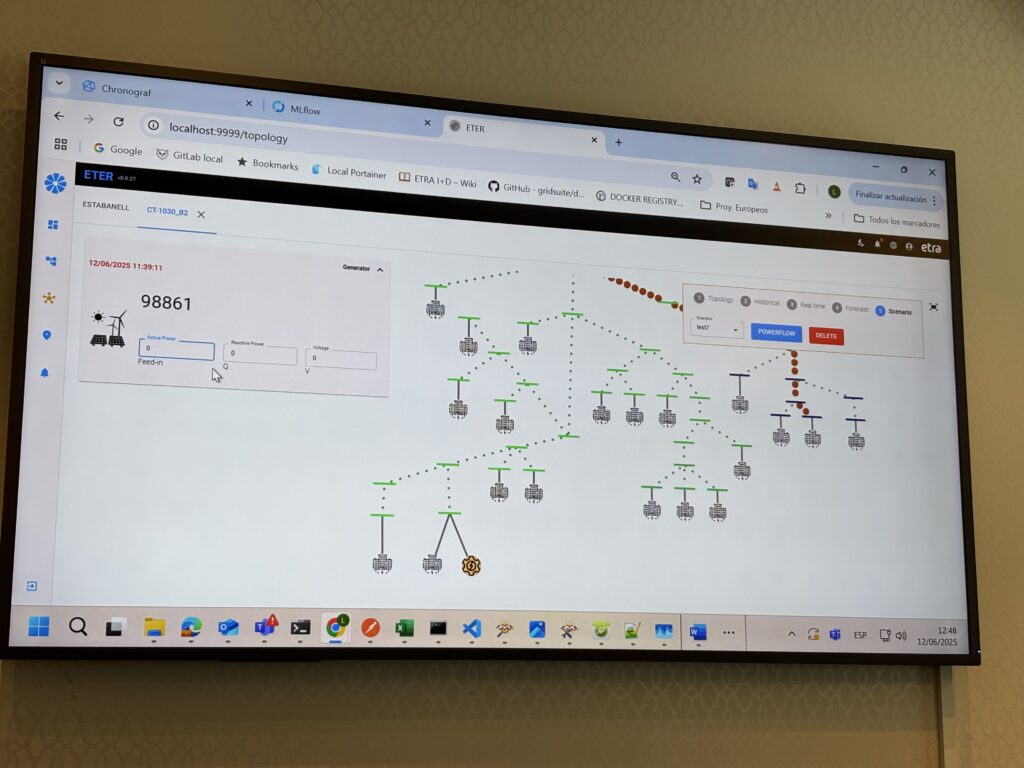
Overall, the feedback was positive, with particular interest in three functionalities that are currently not covered by Estabanell’s existing applications. These include capabilities offered by both ETER and the ICCS tools.
One of the aspects that attracted most attention was ETER’s ability to bring together different data sources in a single environment. By combining real-time information from medium- and low-voltage networks with state estimation algorithms, ETER’s digital twin can provide enhanced observability of the distribution grid.
The teams also highlighted the potential of ETER to support scenario analysis and operational planning. The tool can be used to explore how future changes in grid operation could affect power flows, as well as to assess how the availability of flexibility could help alleviate potential congestion.
Another area of interest was the advanced asset management tool developed by ICCS, particularly its potential to support decisions when purchasing new smart meters by providing additional information on their expected reliability and performance.
The sessions also identified aspects of the solutions that still require further refinement. This feedback will be used by the project partners to improve the tools and strengthen the user experience ahead of the next stages of the pilot.
Moving towards real flexibility activation
Alongside the validation of the technologies with distribution teams, the Spanish pilot has also taken an important step towards demonstrating flexibility in practice.
During the last weeks of July, ETRA, Estabanell and Hypertech carried out the flexibility activation tests planned for the pilot. The activities will continue throughout August, allowing the partners to further assess the performance of the solution and prepare for the next stages of the demonstration.
An encouraging result from the tests carried out so far is that flexibility activations have taken place without users noticing any impact on their service or comfort. This is an important aspect of the demonstration, showing how flexibility can be activated to support the electricity system while maintaining a seamless experience for end users.
The ongoing tests will provide further insights into how the different components developed within OPENTUNITY work together in a real pilot environment. Once the pilot is completed, the partners will analyse the results and share the main conclusions and lessons learned.
From technology validation to real-world demonstration
The latest activities mark an important transition for the Spanish pilot. By combining feedback from distribution professionals with practical flexibility activation tests, OPENTUNITY is moving beyond the development of individual technologies towards integrated, real-world validation.
The coming months will focus on completing the remaining demonstrations and analysing the results, helping the project assess how its solutions can contribute to more observable, flexible and efficient distribution grids while keeping end users at the centre.

Embarking on AI-Powered Non-Intrusive Load Monitoring (NILM) Algorithms
Embarking on AI-Powered Non-Intrusive Load Monitoring (NILM) Algorithms
11/10/2023
ETRA‘s role in this project extends beyond mere coordination; it also involves the delivery of innovative technologies and solutions to empower grid operators. One significant stride in this journey is ETRA’s work in the development of Artificial Intelligence-based Non-Intrusive Load Monitoring (NILM) algorithms. This algorithm belongs to the OPENFLEX innovation.
These advanced algorithms harness data derived from overall household energy consumption, enabling the inference of active appliances and their respective energy usage at any given moment. What sets NILM apart is its ability to achieve disaggregated energy consumption insights without the need for submetering, offering cost-effective benefits to end-users.
ETRA has conducted extensive research in this field, meticulously assessing the State of the Art. The most promising avenue for its work is the development of semi-supervised algorithms, an area that remains relatively uncharted in the realm of AI. Within the OPENTUNITY project, ETRA is committed to expanding knowledge in this domain, ultimately delivering new technology to European households built on this innovative and promising approach.

OPENTUNITY Team Gathers in Ljubljana for Second Plenary Meeting
OPENTUNITY Team Gathers in Ljubljana for Second Plenary Meeting
05/10/2023
From October 3rd to 4th, the OPENTUNITY team convened in Ljubljana for its highly second Plenary Meeting, hosted by the Laboratory of Energy Policy (UL).
During the meeting, partners engaged in comprehensive discussions regarding the latest advancements in their respective tasks. This collaborative gathering facilitated the exchange of invaluable insights and allowed the team to explore the Slovenian site.
From a technical standpoint, the meeting included presentations on the current status of relevant use cases, providing a detailed overview of ongoing research and development efforts. As a result of these discussions, the partners collectively agreed on a set of next steps, including initiating the transmission of data from pilot sites to technical partners as per their requests and finalising the architecture modeling.
In addition to the productive discussions, the visit to Elektro Ljubljana d.d. (DSO) offered the partners a unique opportunity to gain a deeper understanding of the region’s dynamic energy landscape.