


grid operators
Enhancing Grid Reliability in Slovenia: OPENTUNITY Deploys Advanced Transformer Monitoring
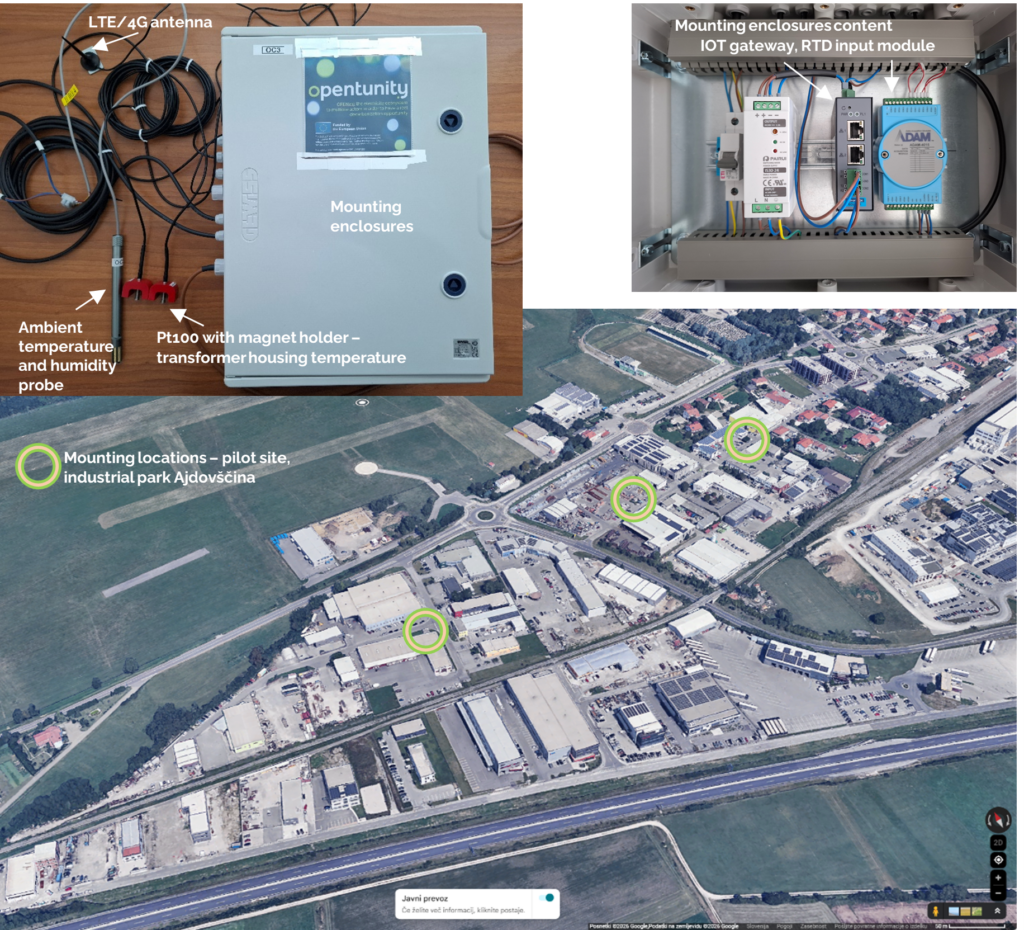
In the drive toward a more resilient and decarbonised European energy grid, monitoring critical infrastructure is paramount. On April 18, 2026, a significant milestone was reached in the Slovenian pilot site of the OPENTUNITY project. Our partner Elektro Primorska (EP), in collaboration with ICCS, successfully installed specialized measurement equipment on three Medium Voltage/Low Voltage (MV/LV) transformers located in the Ajdovščina industrial park.
The Challenge: Real-Time Asset Management
Power transformers are essential components of the electricity distribution network, but they are often the most vulnerable to failure. Traditionally, asset management has been a long-term process, looking at equipment health over months or years. However, to ensure grid stability, there is a growing need for short-term asset management.
The tool developed by ICCS is designed to operate in a near real-time context. Its primary goal is to identify transformers that may be on the verge of failure within hours, allowing operators to intervene before a blackout occurs.
Innovation through Indirect Measurement
To predict these failures, the tool requires precise data on transformer load current,
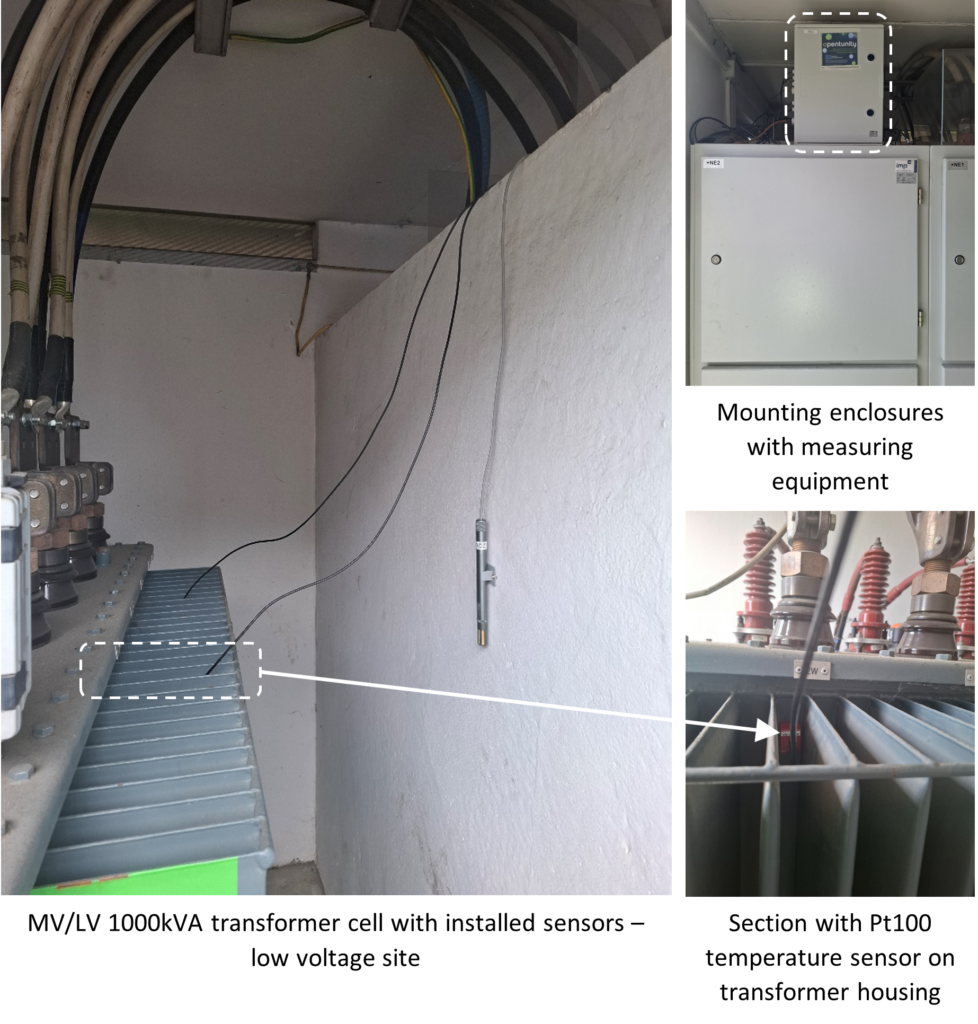
ambient temperature, and top-oil temperature. A technical challenge arises because many older MV/LV transformers are not equipped with built-in top-oil temperature sensors.
To solve this, the team at Elektro Primorska developed an innovative, purpose-built measuring system. Instead of invasive procedures, the system uses Pt100 sensors with magnet holders placed directly on the transformer housing. This allows for the indirect measurement of top-oil temperature through a direct correlation with the housing temperature.
A Robust Technical Setup for Smart Monitoring
The installation at the Ajdovščina pilot site features a high-tech stack of industrial components designed for reliability and speed:
- Data Acquisition: The system utilizes Advantech components, including IoT gateways and RTD input modules, for local data storage and transmission.
- Environmental Sensing: Along with transformer housing temperature, the system includes an ambient probe to measure surrounding air temperature and relative humidity.
- High-Speed Connectivity: Data is transmitted via a secure MQTT protocol over a mobile LTE/4G network.
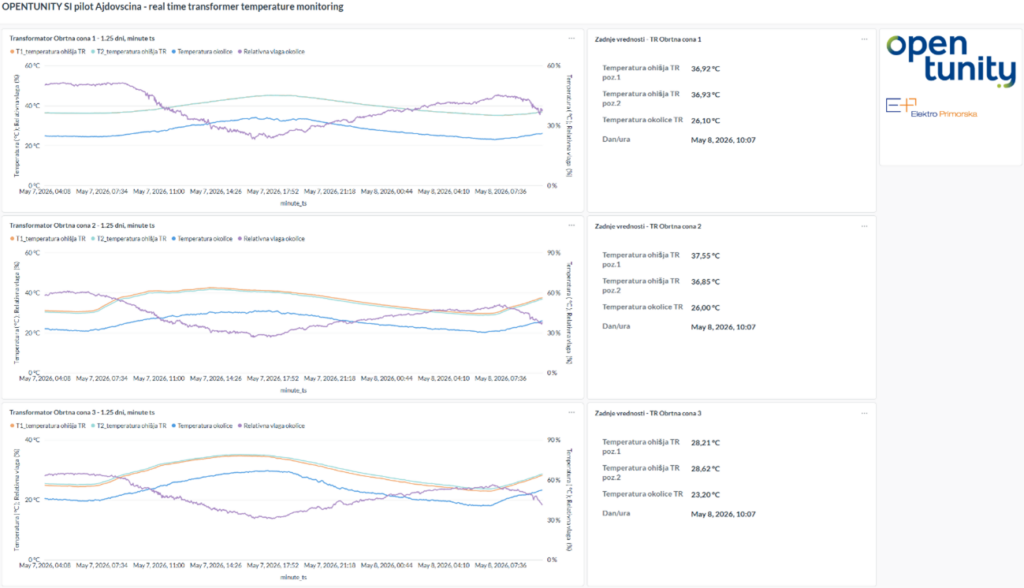
- Real-Time Visualization: Measurements are received at 5-second intervals and stored in an SQL database. This high frequency allows for a real-time dashboard where operators can monitor current and historical data instantly.
 Why This Matters for the Future of Energy
This activity falls under the OPENGRID category of the OPENTUNITY project, which focuses on supporting Distribution System Operators (DSOs) in managing grid issues more effectively. By transforming standard transformers into "smart" assets, Elektro Primorska is demonstrating how existing infrastructure can be upgraded to support a more flexible and digitalised energy ecosystem.
As part of the broader Slovenian pilot, which also involves portions of the grids of Elektro Ljubljana, these advancements are crucial for utilizing the flexibility potential of domestic assets and electric vehicles while maintaining a stable and secure grid.
--------------------------------------------------------------------------------
Project Overview
- Location: Ajdovščina industrial park, Slovenia.
- Partners Involved: Elektro Primorska (EP) and ICCS.
- Key Innovation: Indirect top-oil temperature monitoring for predictive maintenance.

Standardising Peer-to-Peer Energy Trading: Opentunity Leads the Way with New CENELEC Agreement
OPENTUNITY is proud to announce significant progress in its contribution to European standardisation. As a primary promoter, the project is spearheading the CENELEC Workshop Agreement (CWA) titled “Impact of P2P trading at distribution grid level,” a critical step toward harmonising decentralised energy markets across the continent.
A Collaborative Effort for European Standardisation
Launched in 2025, this CWA is the result of a strategic collaboration between two major Horizon Europe projects: OPENTUNITY and FEDECOM. A CWA serves as a formal standardisation deliverable that reflects a consensus between the individuals and organisations responsible for its development. By drawing on the collective outcomes of these projects, the agreement aims to establish a common framework for the implementation of peer-to-peer (P2P) energy trading.
Defining the Framework for P2P Implementation
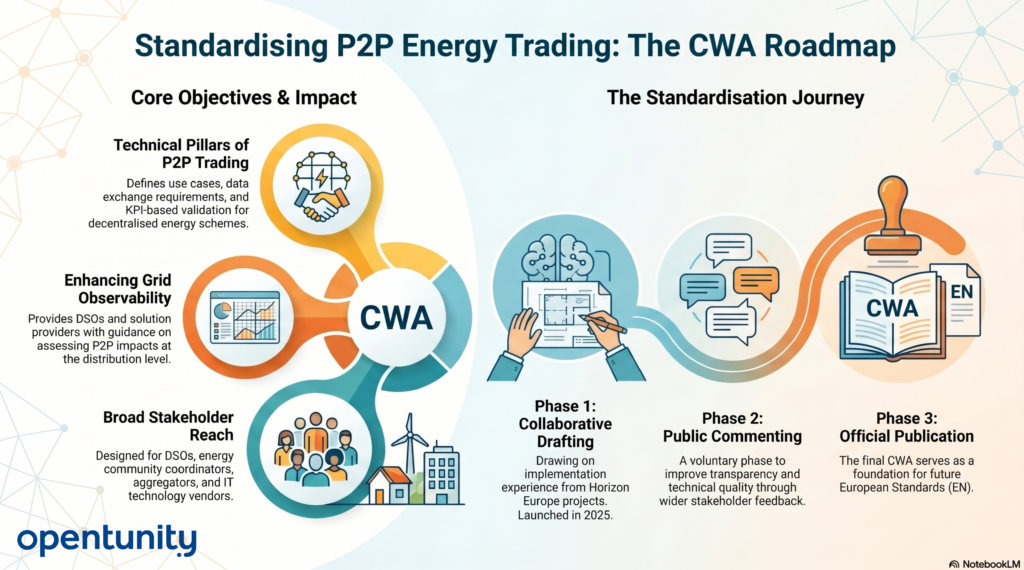
The agreement is designed to be a comprehensive guide for the energy sector. It focuses on several technical and operational pillars necessary for successful P2P integration at the distribution level, including:
- Use Cases and Requirements: Identifying specific scenarios for P2P trading and the necessary data exchange and interoperability standards.
- Grid Observability: Addressing how decentralised trading impacts the monitoring and management of distribution grids.
- Validation Approaches: Establishing KPI-based methods to measure the performance and impact of these schemes.
This CWA will provide essential implementation guidance for a wide range of stakeholders, including Distribution System Operators (DSOs), energy community coordinators, and technology providers such as aggregators and IT integrators.
The Path to Official Publication: Public Engagement
Following the development of a mature draft based on contributor consensus, the document is currently undergoing formal approval by Workshop participants. Once endorsed, the project will enter a vital Public Commenting phase.
This phase allows any interested party to review the text and submit feedback, ensuring the document meets the highest standards of transparency, openness, and technical quality. Engaging a wider pool of stakeholders is considered a highly beneficial step in refining the final agreement.
 Building the Foundation for Future Standards
After the public review, the Workshop will assess all comments to finalise the text for official publication as a CENELEC Workshop Agreement. This document will not only provide a consensual reference for immediate use but will also serve as the foundational roadmap for future European Standards (EN) and Technical Specifications (TS).
By leading this initiative, OPENTUNITY continues to ensure that the innovations developed within the project contribute to a more integrated, standardised, and efficient European energy landscape.

OPENTUNITY innovations at the EUSEW 2024
OPENTUNITY innovations at the EUSEW 2024
03/06/2024
The OPENTUNITY project will participate in the Energy Fair of the European Sustainable Energy Week (EUSEW 2024) in Brussels from June 11th to 13th. Visitors can meet the OPENTUNITY team and learn about their innovations at booth C-28, located on the ground floor of the Charlemagne building. The stand will be hosted by ETRA, the project coordinator, on the morning of June 11th.
The OPENTUNITY innovations aim to revolutionise the energy sector by fostering a digital ecosystem that enhances energy efficiency in electricity grids, benefiting active consumers of all scales while significantly reducing energy costs.
Visitors can explore OPENFLEX, a technology designed for prosumers, and discover how the project’s partners have defined the flexibility market conditions for each pilot where these markets will be tested. Currently, they are working on allowing flexibility optimization algorithms to be tailored to specific market conditions.
Additionally, visitors can learn about OPENGRID, a solution for grid operators. They can see how technical developers, DSOs, and TSOs are collaborating to process the data provided by grid operators. This preprocessing is essential for developing OPENTUNITY innovations and training certain models.
See you there!