


CEN/CLC
Standardising Peer-to-Peer Energy Trading: Opentunity Leads the Way with New CENELEC Agreement
OPENTUNITY is proud to announce significant progress in its contribution to European standardisation. As a primary promoter, the project is spearheading the CENELEC Workshop Agreement (CWA) titled “Impact of P2P trading at distribution grid level,” a critical step toward harmonising decentralised energy markets across the continent.
A Collaborative Effort for European Standardisation
Launched in 2025, this CWA is the result of a strategic collaboration between two major Horizon Europe projects: OPENTUNITY and FEDECOM. A CWA serves as a formal standardisation deliverable that reflects a consensus between the individuals and organisations responsible for its development. By drawing on the collective outcomes of these projects, the agreement aims to establish a common framework for the implementation of peer-to-peer (P2P) energy trading.
Defining the Framework for P2P Implementation
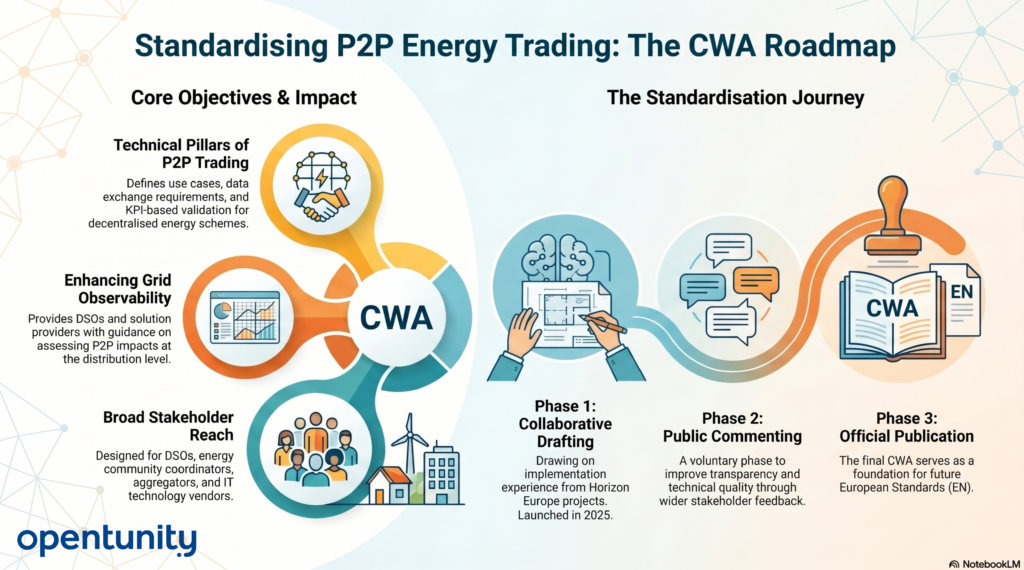
The agreement is designed to be a comprehensive guide for the energy sector. It focuses on several technical and operational pillars necessary for successful P2P integration at the distribution level, including:
- Use Cases and Requirements: Identifying specific scenarios for P2P trading and the necessary data exchange and interoperability standards.
- Grid Observability: Addressing how decentralised trading impacts the monitoring and management of distribution grids.
- Validation Approaches: Establishing KPI-based methods to measure the performance and impact of these schemes.
This CWA will provide essential implementation guidance for a wide range of stakeholders, including Distribution System Operators (DSOs), energy community coordinators, and technology providers such as aggregators and IT integrators.
The Path to Official Publication: Public Engagement
Following the development of a mature draft based on contributor consensus, the document is currently undergoing formal approval by Workshop participants. Once endorsed, the project will enter a vital Public Commenting phase.
This phase allows any interested party to review the text and submit feedback, ensuring the document meets the highest standards of transparency, openness, and technical quality. Engaging a wider pool of stakeholders is considered a highly beneficial step in refining the final agreement.
 Building the Foundation for Future Standards
After the public review, the Workshop will assess all comments to finalise the text for official publication as a CENELEC Workshop Agreement. This document will not only provide a consensual reference for immediate use but will also serve as the foundational roadmap for future European Standards (EN) and Technical Specifications (TS).
By leading this initiative, OPENTUNITY continues to ensure that the innovations developed within the project contribute to a more integrated, standardised, and efficient European energy landscape.


Enhancing OPENTUNITY’s Standardization Strategy: A New Action Plan
Standardization is a key enabler of interoperability, scalability, and long-term impact for innovations in smart grids, flexibility markets, and energy digitalization. As part of OPENTUNITY’s commitment to contributing to the European and international standardization landscape, OPENTUNITY partner UNE is developing a new version of the Standardization Activities Document.
Why Standardization Matters for OPENTUNITY
Standardization ensures that the solutions and methodologies developed within OPENTUNITY can be widely adopted and integrated into existing frameworks. By aligning with standardization bodies and contributing to the evolution of relevant standards, OPENTUNITY can help shape a coherent regulatory and technical framework for the future of flexibility markets and digital energy systems.
What’s New in the Standardization Activities Document?
The revised document builds upon the key conclusions of Deliverable D2.2, which analyzed the current standardization landscape relevant to OPENTUNITY’s objectives. It provides:
- A detailed action plan for the next steps in engagement with standardization bodies (Subtask 8.1.1) and contributions to standardization (Task 7.5).
- Guidelines for disseminating OPENTUNITY’s results in a way that supports future standardization activities.
- A timeline and responsibilities to ensure effective coordination of standardization-related efforts.
Next Steps: Driving Standardization Forward
With this updated document, OPENTUNITY will focus on:
- Strengthening collaboration with technical standardization bodies at European and international levels.
- Ensuring alignment between OPENTUNITY’s developments and existing or emerging standards.
- Maximizing impact by integrating OPENTUNITY’s innovations into industry-wide practices and regulatory frameworks.
By actively engaging in standardization, OPENTUNITY aims to create lasting value for the energy transition, digital grids, and flexibility markets. Stay tuned for more updates on our progress!
Download the latest version of the Standardization Activities Document here:

Latest Updates on OPENTUNITY’s Work with Standardization Bodies
As part of OPENTUNITY, our partner UNE has been actively engaging with key standardization committees. The goal is to establish connections that can foster collaboration in standardization efforts relevant to the project's scope. Here, we outline our progress and focus areas.
Initial Engagement with Committees
Initially, we identified eight technical committees for a first round of contact. The main objective of this outreach was to introduce the OPENTUNITY project and create a communication channel for potential contributions to standardization or liaison opportunities.
We provided them with a brief summary of the project, covering aspects such as Work Packages, Pilot sites, Use Cases, and Innovations, while also inviting their interest and feedback. So far, four technical committees have responded positively with varying levels of interest:
- CEN & CENELEC Focus Group on Data, Dataspaces, Cloud, and Edge
- COG-SG
- CLC TC 13
- CLC TC 57
Currently, we are focusing on potential collaboration with these committees as well as two newly established Joint Technical Committees:
- JTC 24: Digital Product Passport - Framework and System.
- JTC 25: Data Management, Dataspaces, Cloud, and Edge (DDCE) (which replaces the previous focus group).
These committees are working on crucial aspects relevant to OPENTUNITY, making them valuable partners in our standardization efforts.
The Digital Product Passport (DPP)
One key area of standardization involves the Digital Product Passport (DPP), a digital identity card for products, components, and materials. The DPP aims to enhance product sustainability, promote circularity, and ensure regulatory compliance. It will contain essential information accessible electronically, such as: user manuals, materials used, environmental impact assessments and recycling instructions.
As part of the Ecodesign for Sustainable Products Regulation (ESPR), many products sold in the EU will be required to have a DPP. Other regulations, including those for batteries and construction products, also consider the DPP as a critical element.
To support the implementation of the DPP, the European Commission (EC) has issued a Standardization Request to CEN & CENELEC for the development of eight European standards, expected to be published before 2026. These standards will focus on the IT infrastructure necessary for DPP functionality rather than the specific data it will contain, which will be determined through future delegated acts.
European Trusted Data Framework and Dataspaces
Another crucial area of our standardization efforts is dataspaces. The EC has launched a Standardization Request for a European Trusted Data Framework, which is expected to result in the development of eight new standards. Our team is closely monitoring and engaging in these standardization activities to ensure OPENTUNITY aligns with and contributes to the evolving regulatory landscape.
Conclusion
Through our engagement with key standardization committees and active participation in critical regulatory developments, OPENTUNITY is positioning itself at the forefront of emerging standards in digital identity, sustainability, and data management. We will continue to foster collaborations and contribute to the evolving framework for a more interconnected and standardized digital ecosystem.

OPENTUNITY Strategy for the development of the standardization activities
OPENTUNITY Strategy for the development of the standardization activities
17/05/2024
Following an in-depth analysis of the standardization landscape and socioeconomic backdrop, the OPENTUNITY partners uncovered several European and international technical committees, along with existing and emerging standards, that align closely with the objectives of various project work packages. Recognising this synergy, proactive measures were implemented to engage with the standardization system. These actions aim not only to disseminate project findings effectively but also to actively contribute to ongoing and forthcoming standards initiatives, thereby fostering collaboration and promoting the project’s impact across diverse domains.
Therefore, partners, led by UNE, have been working on a strategy for the development of the standardization activities document, which specifies an action plan for the next tasks involving communication with technical standardization bodies and contributions to standardization. At this moment, the first version of this strategy has been defined, and it will be updated accordingly, as the project progresses.
This strategy has been developed by UNE with feedback from OPENTUNITY partners. Together, they identify possible standardization gaps that could be addressed with the results of the OPENTUNITY project. The purpose of this strategy is to provide partners with a clear idea of the next steps and ensure the most effective possible contribution of the project results to new or future standards.
This strategy includes:
– Key Technical Committees to interact with and information about them.
– Next steps, including the follow-up of the activity of relevant committees and the involvement of partners in disseminating the project in these committees.
– Possible ways to contribute to standardization.
The main objective of the standardization activities in OPENTUNITY is to facilitate the market acceptance of the results by transferring these results and findings to standards that have a wide recognition in the market.
Communication will be established between the OPENTUNITY project, and the key committees identified by the partners, disseminating the project, and obtaining valuable feedback. Additionally, OPENTUNITY will be able to contribute to the activity of these committees and European/international standardization with its results.
As part of the contribution to standardization tasks of OPENTUNITY, UNE plans to collaborate with other standardization bodies, such as the European Standardization Organizations (ESOs) and their Technical Committees and Subcommittees. The goal of the project is to decarbonize EU grids, and CEN/CLC Workshop Agreements are usually the most suitable way to contribute to standardization in this kind of projects. Nevertheless, ISO/IEC (International Standardization Organizations) committees and the Connectivity Standards Alliance are also listed among the suggested committees to be considered.