Innovations

OPENTUNITY provides innovations that facilitate the integration of distributed flexibility systems, such as batteries or electric vehicles and develops new market mechanisms, into the European Smart Grids. These systems play a key role in supplying more flexibility and balance to the grid and providing backup to intermittent renewable energy.
OPENTUNITY plans to deploy twelve innovations that fall into four categories:
OPENSPACE
Federated Data Space Infrastructure (SOFTWARE)

Goal: To design an open, secure, and trusted
platform for data exchange between energy assets and systems by leveraging the concept of Decentralized Identifiers (DIDs) and Verifiable Credentials (VCs).
Beneficiaries: DSOs/TSOs, aggregators and OEMs.
Demonstration pilots: Greece, Slovenia, Spain, and Switzerland.
OPENFLEX
Flexibility in Prosumer’s environment (SOFTWARE)

Goal: To enable flexible delivery and valorisation of energy assets within buildings, including stationary storage and electric vehicle chargers, a range of activities are required. These activities include user-friendly installation and commissioning of a state-of-the-art Energy Management System (EMS), as well as selling the flexibility in local flexibility markets.
Beneficiaries: ESCOs, aggregators, small and medium prosumers, facility managers, EV carsharing companies, market operators, and DSOs.
Demonstration pilots: Greece, Slovenia, Spain, and Switzerland.
OPENGRID
Technologies for DSOs/TSOs to better manage grid issues (SOFTWARE)

Goal: To provide powerful grid monitoring and control that facilitates real-time information on the status of the grid and analyses the flexibility requirements of the grid to kick off demand response campaigns.
Beneficiaries: DSOs, TSOs
Demonstration pilots: Greece, Slovenia, Spain, and Switzerland
OPENABILITY
Procedures for enhancing interoperability (METHODOLOGIES)

Goal: To provide a set of new methodological procedures that will enhance the interoperability and collaboration between different actors of the energy system.
Beneficiaries: IT developers and companies, Universities and Research centres, DSOs and TSOs, OEMs, ESCOs and small and medium prosumers.
Demonstration pilots: Greece, Slovenia, Spain, and Switzerland
OPENSPACE
ENERGY-SPECIFIC BLOCKCHAIN FOR SUPPORTING NEW GRID MECHANISMS
Decentralized identifiers
Interoperability with other platforms and management of their historical data
OPENFLEX
TECHNOLOGIES TO BOOST FLEXIBILITY IN PROSUMER’S ENVIRONMENT
Home Energy Management System (HEMS) & Building Energy Management System (BEMS) flexibility and demand response optimization including initial settings algorithms
AI non-intrusive load monitoring algorithms
Optimal Selection of Available Flexibility by Aggregators
Flexibility market design and management
OPENGRID
SUPPORTING TECHNOLOGIES FOR DSOs/TSOs TO BETTER MANAGE GRID ISSUES
Topology identification and state estimation via machine learning
Low-cost real-time thermal rating
Advanced asset management
Grid planning methodologies
OPENABILITY
PROCEDURES FOR ENHANCING INTEROPERABILITY
Plug and play recognition for flexibility devices
Integration of DSO and TSO ICT infrastructures into energy management systems
OPENTUNITY Products

OPENSPACE
Connecting data across the energy ecosystem
An interoperable data space enabling secure and seamless data exchange between DSOs, aggregators, prosumers and other energy stakeholders.
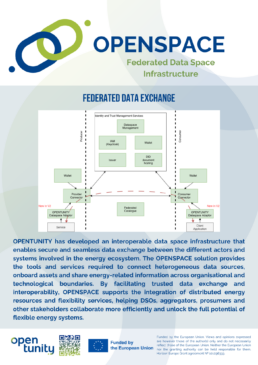
Federated Data Exchange
OPENTUNITY has developed an interoperable data space infrastructure that enables secure and seamless data exchange between the different actors and systems involved in the energy ecosystem. The OPENSPACE solution provides the tools and services required to connect heterogeneous data sources, onboard assets and share energy-related information across organisational and technological boundaries. By facilitating trusted data exchange and interoperability, OPENSPACE supports the integration of distributed energy resources and flexibility services, helping DSOs, aggregators, prosumers and other stakeholders collaborate more efficiently and unlock the full potential of flexible energy systems.
Scientific Publications:

OPENFLEX
Unlocking flexibility from distributed energy resources
Solutions that help identify, manage and activate flexibility from distributed energy resources, enabling consumers, prosumers and other energy actors to play a more active role in the energy system.
Building Flexibility Management System
The Building Flexibility Management System is a back-office digital platform that implements the operations of the Flexibility Service Provider with regards to the discovery, coordination and valorisation of electricity demand flexibility from building-deployed appliances and equipment. It leverages IoT or cloud data integrations with appliance vendors to contextualise building operations and comfort requirements in order to forecast and optimise asset operational schedules and extract flexibility in their electricity demand profile. This flexibility is aggregated over appliances and buildings and collectively (or individually if the market code permits) offered in Local Flexibility Markets in response to flexibility requests by perspective buyers (e.g. DSOs to resolve network bottlenecks such as congestion).
Optimal Selection of Available Flexibility by Aggregators
OPENTUNITY has developed two complementary algorithms that help aggregators and flexibility service providers make the most of their portfolios of distributed energy resources.
Market selection: based on baseline and flexibility forecasts, market price forecasts, network tariffs and technical and regulatory constraints, the algorithm identifies the most profitable market or combination of markets (day-ahead, intraday, TSO ancillary services or DSO local flexibility markets) together with the corresponding operating schedule.
Optimal asset selection: when a flexibility activation is requested, a rolling-horizon genetic algorithm decides which assets to activate, such as EV chargers, batteries, PV systems and heat pumps. Assets are ranked by their short-run marginal cost, so the request is delivered at minimum cost while respecting technical limits and user comfort.
Scientific Publications:
- Analysis of Consumption Forecasting and Flexibility Utilization of an Electric Vehicle Fleet in the OPENTUNITY Project.
- A Rolling-Horizon Optimal Selection Algorithm for Disaggregating Flexibility in Heterogeneous Asset Portfolio
- Analysis of load forecasting and flexibility utilization of the HEMS fleet in the OPENTUNITY project
AI non-intrusive load monitoring algorithms Optimal Selection of Available Flexibility by Aggregators
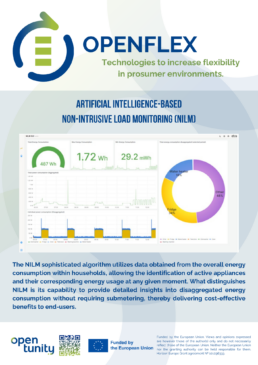
The NILM sophisticated algorithm utilizes data obtained from the overall energy consumption within households, allowing the identification of active appliances and their corresponding energy usage at any given moment. What distinguishes NILM is its capability to provide detailed insights into disaggregated energy consumption without requiring submetering, thereby delivering cost-effective benefits to end-users.
Flexibility market design and management

OPENGRID
Making distribution grids more observable
Digital solutions that improve grid observability, state estimation and network understanding, helping DSOs make better-informed decisions and operate increasingly complex distribution networks.
Topology identification and state estimation via machine learning
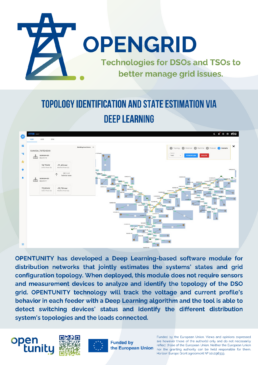
OPENTUNITY has developed a Machine Learning-based software module for distribution networks that jointly estimates the systems’ states and grid configuration topology. When installed, this module will not require sensors and measurement devices to analyze and identify the topology of the DSO grid. OPENTUNITY technology tracks the voltage and current profile’s behaviour in each feeder with a Deep Learning algorithm and the module is able to detect switching devices’ status and identify the different distribution system’s topologies and the loads connected.
Low-cost real-time thermal rating
OPENTUNITY has developed a low-cost real-time thermal rating tool that allows Distribution System Operators to assess the actual capacity of medium-voltage overhead lines instead of relying on conservative static ratings. The tool combines historical and real-time current measurements with high-resolution weather forecasts and machine learning models to estimate conductor temperature along the line and calculate the maximum permissible current. Probabilistic forecasts of current, conductor temperature and thermal rating are provided up to six hours ahead, and the results are displayed on real-time and historical dashboards. By unlocking spare line capacity without requiring extensive sensor deployment, the solution helps reduce congestion and renewable curtailment and can postpone investment in new lines.
Short-term asset management
OPENTUNITY has developed a short-term asset management tool to help Distribution and Transmission System Operators monitor power transformers and identify abnormal operating conditions. Using online measurements, advanced analytics and machine learning, the tool detects top-oil temperature anomalies, assesses bushing insulation condition and evaluates dissolved gas concentrations. It also forecasts top-oil temperature six hours ahead to highlight potentially critical operating conditions. Real-time alerts and historical dashboards provide actionable insights, helping operators prioritize preventive maintenance, reduce the risk of unexpected failures and improve the reliability of critical power grid assets.
Long-term asset management
OPENTUNITY has developed a predictive asset management tool that helps Distribution System Operators anticipate smart meter failures and support data-driven maintenance and replacement planning. The tool combines historical installation and failure data with smart meter measurements to generate End-of-Life curves and estimate the expected number of failures over a selected future horizon. Machine learning techniques are also used to identify individual smart meters with a high probability of failure, allowing operators to prioritize inspections and replacements. By moving from reactive maintenance towards risk-based asset management, the solution can reduce unnecessary field inspections, improve resource allocation and enhance the reliability of large-scale smart metering infrastructure.
Grid planning methodologies
Developed by ICCS within OPENTUNITY, the Network Planning Tool supports Distribution System Operators in planning network development while incorporating flexibility-based solutions. Its capabilities include fast power-flow analysis and optimisation methodologies to compare conventional grid reinforcements with flexibility-based alternatives. Through a graphical interface, users can evaluate how flexibility can defer network upgrades, reduce investment costs and increase renewable energy hosting capacity. The tool supports OPENTUNITY’s objectives of decarbonisation and stakeholder empowerment by enabling efficient use of flexibility in network planning.
Scientific Publications:

OPENABILITY
Making grid digitalisation easier to integrate
Tools and methodologies that simplify the integration of network data and new digital technologies into existing grid management systems.
Plug and play recognition for flexibility devices
Integration of DSO and TSO ICT infrastructures into energy management systems
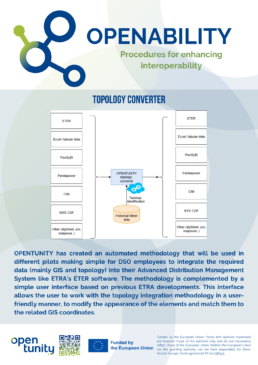
OPENTUNITY has created an automated methodology that will be used in different pilots making simple for DSO employees to integrate the required data (mainly GIS and topology) into their Advanced Distribution Management System like ETRA’s ÉTER software. The methodology is complemented by a simple user interface based on previous ETRA developments. This interface allows the user to work with the topology integration methodology in a user-friendly manner, to modify the appearance of the elements and match them to the related GIS coordinates.